
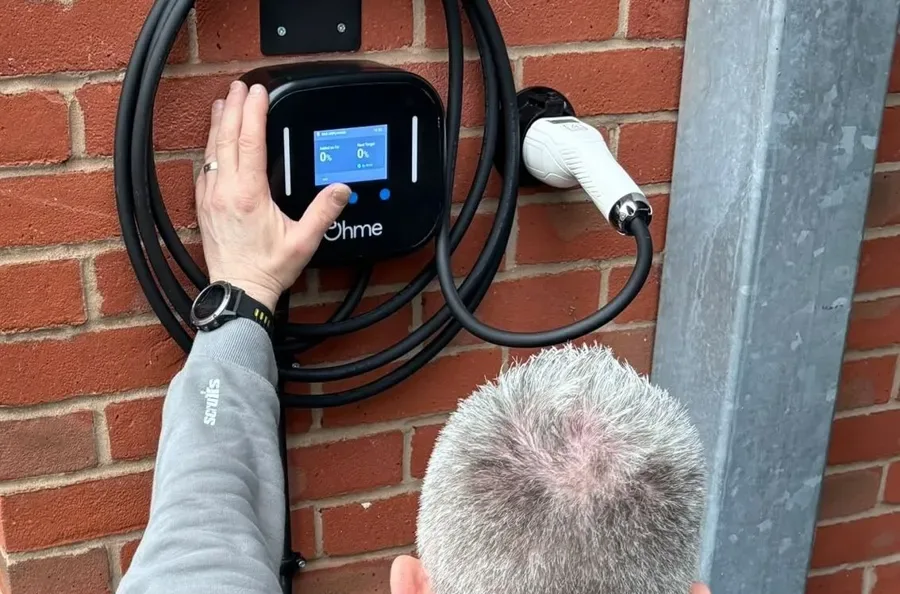

As more of our customers in Bedfordshire, Buckinghamshire and Hertfordshire move to electric cars, home charging has become a frequent topic of conversation. A dedicated charge point can make everyday use much more convenient. Before arranging one, it helps to understand the installation, the equipment choices and what your property needs.
We fit all the most popular charger brands. Below, we answer the questions customers bring to us when deciding how to charge at home.
Do I Really Need A Dedicated Home Charger?
Answer: Not Strictly, But It’s Much Faster, Safer And More Convenient
A portable charging lead, sometimes called a “granny cable”, allows compatible cars to use a suitable three-pin socket. It is slow, and a socket and circuit must be suitable for the sustained load. For regular home charging, a properly installed dedicated charge point is generally the more practical option.
Having your own charger means you can plug in on arrival home and charge overnight, often on a cheaper electricity rate. That avoids relying entirely on public charge points, which may be occupied, out of order or inconveniently placed, and usually cost more per mile.
How Long Does It Take To Charge An Electric Car At Home?
Answer: Usually Overnight, Depending On Your Car And Charger
A typical home charge point on a single-phase supply delivers around 7kW. Many cars can be replenished overnight at that rate, while a shorter session may replace the energy used for a day’s driving. The actual time depends on the battery, starting charge and the rate the vehicle accepts.
An ordinary three-pin supply charges much more slowly; a full charge can take a day or longer. The battery’s size and maximum charging rate limit the result, so use your vehicle’s specifications when estimating the time you will need.
Do I Need A Qualified Electrician To Install An EV Charger?
Answer: Yes, It Should Always Be Installed By A Qualified, Registered Electrician
The installation needs a dedicated circuit with appropriate cable sizing, protective devices and earthing. An incorrectly designed or installed supply can trip unnecessarily or present a serious electrical hazard. Those details need to be assessed for the property and charger.
New domestic circuits are notifiable under Building Regulations. A registered installer tests the work, provides an Electrical Installation Certificate and arranges the building control notification. Professional installation and documentation may also be conditions of the manufacturer’s warranty. EMAY Electrical’s installers are NAPIT registered and fully insured.
How Much Does Home EV Charger Installation Cost?
Answer: It Varies With The Charger And Your Property, So A Survey Is Best
Several details affect the installation price. These include:
- Your chosen charger’s brand and model
- The distance between the consumer unit (fuse box) and the charging position
- The cable route, including whether it can be fixed to a surface or must be buried
- Available space and electrical capacity for an additional circuit at the consumer unit
- Any extra protective equipment required, including surge protection where appropriate
We survey the property before quoting because cable routes and existing equipment vary from home to home. You then receive a clear, fixed price, with no hidden extras.
Are There Any Grants For EV Charger Installation?
Answer: Yes, But Mainly For Flats, Rented Properties And Businesses
Chargepoint funding depends on your circumstances. Support is available for eligible renters, flat owners, landlords and workplaces, and a separate scheme covers qualifying households with on-street parking using an approved cross-pavement solution. The former broad offer for owner-occupiers with houses has ended, so check the scheme that fits your situation.
Use the current GOV.UK electric vehicle chargepoint grants guidance to confirm the rules before committing to an installation. As a registered installer for the EV Chargepoint Grant, we can discuss likely eligibility with you. Our commercial electrical services page covers work at business sites.
Will I Need A New Consumer Unit?
Answer: Sometimes, If Your Current One Lacks Space Or Up-To-Date Protection
We need to establish how a dedicated charging circuit can be safely supplied. That means checking capacity, spare ways and the protection in the existing consumer unit, including the surge-protection requirements that apply. An older board may need upgrading, but its age alone does not decide the answer.
If the survey shows that an upgrade is needed, we explain the reason and include it in the quote. A suitable consumer unit supports safe charging and protects the household installation. You can read more on our consumer unit upgrades page.
Do I Need Permission To Install A Charger At Home?
Answer: Usually Not, If You Own The Property And Have Off-Street Parking
Many installations on a homeowner’s private driveway or wall can proceed under permitted development rights, provided the relevant conditions are met. The electrical work still needs the appropriate certification and building control notification, which the installer handles.
For a rented home or flat, obtain any consent required from the landlord or freeholder. Listed buildings, conservation areas and other restricted sites need particular checks. Confirm the planning position and property permissions before installation, as the rules depend on the site.
Which Charger Should I Choose?
Answer: It Depends On Your Car, Budget And How You Like To Charge
Think about how you would like to plug in each day. A tethered charger keeps its cable permanently attached for convenience; with an untethered unit, you connect your own cable. The latter offers a tidier appearance and the flexibility to change cables later.
App controls and scheduling can help you track consumption and charge during off-peak periods. Some models can also make use of solar generation. Our installations cover popular brands such as Ohme, Pod Point, Zappi, Hypervolt, Rolec, Wallbox and Tesla, and we can help you choose one that suits your needs.
Can Someone Else Use My Charger Without Permission?
Answer: It’s Unlikely, And Most Smart Chargers Let You Lock Them
Unauthorised charging is generally not a concern on a private drive, but many smart units include a lock or app-controlled authorisation. The features depend on the model. An isolator can also be fitted to disconnect the charger when it is not in use.
EMAY Electrical’s Home EV Charger Checklist
- Plan the parking position and a suitable charger location, ideally near the consumer unit
- Find your car’s maximum supported charging rate in its specifications
- Choose between an attached cable and an untethered unit that uses your own
- Confirm grant eligibility before arranging the installation
- Choose a qualified, registered installer and keep the installation certificate
Speak to us about charging at home or read more about our EV charger installation service. We can arrange a free survey and quote as soon as possible.
*EMAY Electrical Services Ltd accepts no liability for acting or failing to act on any advice given.